March 25, 2012

Biscayne, South Beach and Calle Ocho in Miami

Day Three (Monday, March 12th):

We got up and moving early Monday due to the noise of the sprinklers in the fields next door. We headed straight to Biscayne National Park. 95% of the park is underwater and the best way to see it is by doing a snorkeling tour but they are not running this time of the year. Biscayne is also known for its mangroves.In the 1960's the area was considered for an oil refinery which locals supported because of jobs but environmentalists decried. In 1968, when it appeared the area was about to become a national monument, oil supporters bulldozed a highway six-lanes wide right down the center of the island, destroying the forest for seven miles. They called it Elliott Key Boulevard, but called it Spite Highway privately. It was hoped that since there was so much environmental damage, no one would want it for a national monument. However, park proponents were not deterred and President Lyndon B. Johnson signed the bill on October 18, 1968. It was warmer in Biscayne but still very windy. We scoped out the visitor center and did a short walk and got to see some sea foam and a random Man of War that had washed up on the beach.

At the end of the walk is designated an Important Bird Area because of the numerous protected species.Next up was South Beach, Miami. It was gorgeous! There were purple flag warnings due to all the Man of War that had washed up on the beach but we still enjoyed strolling along the water’s edge. We dined at Puerto Sagua for lunch which is a Cuban restaurant. It was delicious. After leaving the restaurant, we strolled through the shopping area and in a moment of weakness I purchased a bright pink tank top that was emblazoned with “I’m in Miami, Bitch!”. Probably not meant to be worn by anyone not on Spring Break but for some reason I love it!
Our last stop in Miami was Little Havana, specifically Calle Ocho. Jess wanted to stop by a Cigar Factory so we parked along a glass strewn side street and hurried in and out as the neighborhood did not look particularly tourist friendly. The shop smelled good and the guy was nice but the cigars were very expensive. We headed down to Key Largo to our campsite for the night. However, upon arrival we saw that the campground consisted of a narrow dirt road lined with RVs. There was one small spot with a fire pit between two huge RVs that we determined would be our spot. No bathroom facilities were in view. After waiting 5 minutes for someone to greet us and then be told to call someone else (whose phone number didn’t work) and then told to wait in the common area (aka a picnic table of smokers surrounded by beer cans), we determined that it was not the place for us to spend the night. We wheeled out of there and went to Key Largo Kampground where we snagged the last available spot. The guy wouldn’t let us pay until we had checked out the site because he feared we wouldn’t like it but considering there was a bathroom, we were content with it. We got settled in and relaxed for the night in our safe and secure campground.

March 23, 2012

Orlando, Canaveral and Cocoa Beach

Day One (Saturday, March 10th):
Well it’s been a while since I have last blogged but I’m going to make up for it with the amazing Island Hopper Loop road trip I have just completed! I headed back down to Florida, the homeland of my BFF Jess where she had planned out a South Florida adventure. Jess’ friend Lindsay was also along for the ride.
I arrived on time at the Orlando Airport and was greeted by Jess, Lindsay and Claire (Jess’ sister). I was whisked off to Downtown Disney which is an avenue of shops and restaurants that is free to get into. We drove under the famous Walt Disney World sign which was neat. We ate at the T Rex restaurant which was a huge sensory overload. It’s like a Rainforest CafĂ© but a prehistoric version. Dinosaurs move around, fish hang from the ceiling and every once in a while a meteor shower descends. Plus it is jam packed with people and waiters scurrying around. It was stressful just eating there, I can't imagine working there.

Day Two (Sunday, March 11th):The next day we headed over to Canaveral National Seashore. It was cloudy and windy and the waves were crazy. I dipped my toe in but there wasn’t anyone on the beaches due to the weather. Canaveral is known for their sea turtles and while this wasn't the right time of year, the visitor center has a nice display of some shells.There's a short path to the Eldora State House. The residence has been rehabilitated and now holds photos and artifacts that tell the story of the town of Eldora and the people who lived there. Eldora was a prominent community of orange groves in the latter part of the 19th century. After a freeze destroyed most of its crops, it was nearly completely abandoned and has never regained its population. Its last resident died in the 1980’s.After leaving Canaveral we drove down to the “World Famous Ron Jon’s Surf Shop”. There are signs for this place everywhere along the interstate. It’s basically a surf shop but they have live bands playing and tons of beachy gear. We only stayed long enough to walk to the bathrooms as we wanted to get to Miami by nightfall. Plus none of us were in the market for a surfboard.We made it to the Miami Everglades Resort just as the sun was setting and got the tent set up. Here is Officer McGator, guarding the entrance and enforcing the speed limit.

December 15, 2011

Hopewell Culture and McKinley Memorial

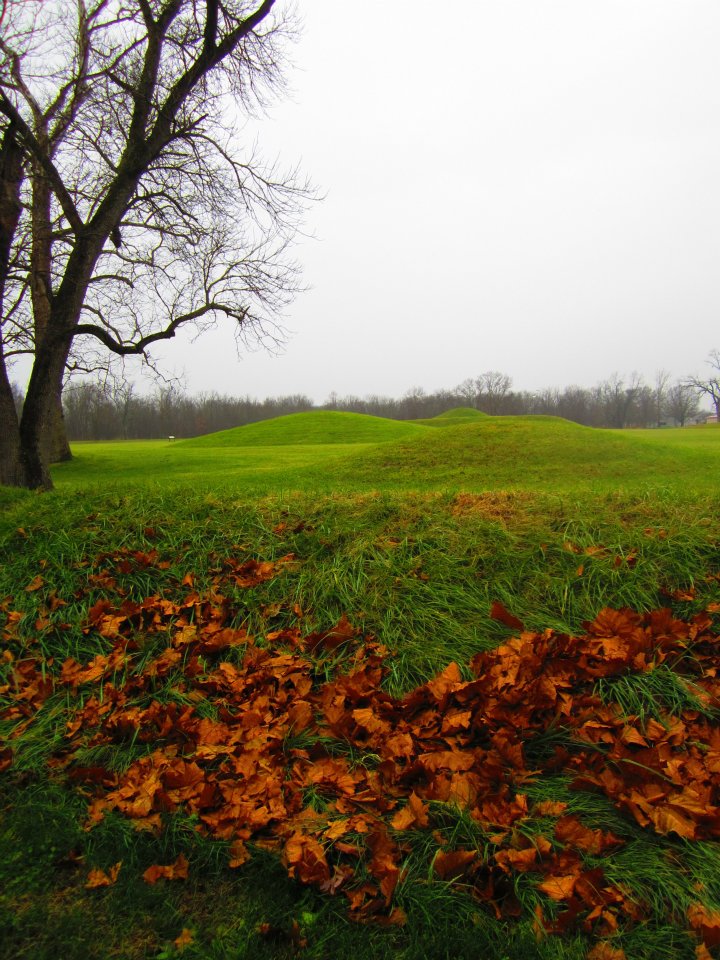
My luck with gorgeous weather ran out and Sunday dawned gray and rainy. However, it was in the 50s so it was a nice warm rain and I couldn’t complain. My last day of this Thanksgiving trip brought me to Hopewell Culture Historic Park in Chillicothe, OH. I got to the mounds about 8am and walked the self-guided interpretive trail of the mounds. This place was so unlike anything I had seen before and it was very interesting to learn about. The Hopewell tradition was not a single culture or society, but a widely dispersed set of related populations connected by a common network of trade routes. Hence why many artifacts were found here that originated in other areas of the United States. The greatest concentration of Hopewell ceremonial sites are in the Scioto River Valley. These cultural centers typically contain a burial mound and a geometric earthwork complex that covers ten to hundreds of acres. No one really has a clear idea of why the mounds were built. Although many do contain burials, some scientists think that these mounds were built as a lunar observatory. There is also another trail circles the outer perimeter of these earthworks. Part of the trail follows the Scioto river. Across the river is another mound group that is not open to the public as it is still being explored.There is also an old lock along the perimeter trail.After I finished walking the trails, I went inside to the visitor center where there is a small museum with more information about the Hopewell People and some artifacts. Here is an artists rendering of what they may have looked like.

After leaving the park I headed towards home. I decided to drive part of the way on U.S. 40 aka the National Road. On last year’s Thanksgiving road trip in PA I learned all about Washington and how he helped create the National Road while fighting at Fort Necessity so I thought it fitting that I drive some of it. However it runs East/West and I needed to head north so I hopped back on the highways. I saw a sign for William McKinley birthplace and memorial which piqued my interest so I hopped back off the highway. William McKinley was the 25th President of the United States. He was born in Niles, OH and there is a small plaque outside of his birth home. What really caught my eye though was the large memorial in town. I pulled up behind it and when I approached there were two huge gates with a lock on them. Upon closer inspection I saw that it wasn’t really locked and I pushed my way in. There is a museum and presidential library but neither were open so I wandered around the small garden with his memorial in the middle.
It is quite a large monument and very impressive. It was a nice place for a rest before the long drive home.


December 13, 2011

Cincinnati, William Howard Taft, and Kentucky

Driving down to Cincinnati I caught sight of an IKEA so I decided to stop by and check it out to see what all the fuss is about. I did a lap through the massive store (300,000 square feet!!) which took about 20 minutes. I guess the concept is that you get ideas on the second floor and then you go down to the first floor to pick up everything you liked from above. Honestly it was way too much stuff so I got out of there as soon as I could.

Cincinnati is the home of William Howard Taft, the 27th president of the United States and his boyhood home is preserved as a NPS site. Before my tour started I spent some time in the visitor center and learned all about the Taft family (who apparently are the Kennedy’s of Ohio). The Taft family members have served in various positions, such as Governor of Ohio, Governor of Rhode Island, U.S. Senator (two), U.S. Representative (two), Attorney General, Secretary of War (two), United States Secretary of Agriculture, President, and Chief Justice. Every half hour there is a tour of the home William lived in from his birth in 1857 until he went away to college in 1874.

Here's a childhood portrait. Yes he is deliberately dressed like a little girl.

We had a short tour with the ranger and then were free to wander and explore the exhibits. I learned a lot of great information about William. For instance, I never knew that after he was President he became the tenth Chief Justice of the United States (1921–1930). He is the only person to have served in both offices. Taft is also the last President to have sported facial hair while in office. And he was the first president to be buried at Arlington National Cemetery.

He also was instrumental in the construction of the first separate and spacious United States Supreme Court building (the one that is still in use now). He believed that the Supreme Court needed to distance itself from the Congress as a separate branch of the Federal Government. Until then, the Court had heard cases in Old Senate Chamber of the Capitol Building. The Justices had no private chambers there, and their conferences were held in a room in the Capitol's basement.
I like this picture of a cow grazing on the front lawn of the White House.

Taft is known for his large size.His wife as First Lady came up with the idea to plant the cherry trees along the Tidal Basin in D.C. where we can now enjoy them every year at the Cherry Blossom festival (attended in April 2011 by yours truly)!

I enjoyed my time at Taft’s home as I had never really known much about him. My favorite part of my visit though was when I got myself a Junior Ranger Badge! You can only enter the home with a ranger but after your tour you are free to stay and explore the exhibits. I of course spent a lot of time there and let myself out a half hour later. Walking back to the visitor center I saw another couple entering the home but I assumed they were going back in because they had forgotten something. However, a ranger came running out of the visitor center shouting at them. He looked at me and said “why didn’t you stop them!”. I said “I don’t have a badge, I can’t yell at people”. He laughed and took me back to the visitor center and presented me with my very own junior ranger badge and told me “there, now you have the authority to yell at people”. I was so happy and I had the biggest smile on my face. It’s my first badge! Thank you Ranger.Since the weather was so gorgeous (68 degrees and sunny!!) I decided to head over to Devou park in Covington, Kentucky. I walked a short nature trail that was very muddy but spent most of my time on a picnic table overlooking the river and downtown Cincinnati. It was a very scenic spot and obviously very popular as there were a bunch of people taking pictures with the vista in the background.