December 6, 2011

National Museum of the U.S. Air Force

I decided to make a quick stop at the U.S. Air Force Museum but I ended up staying until closing time because it was so marvelous. Not only is this the world's largest and oldest military aviation museum with more than 360 aircraft and missiles on display but admission to the museum is free! They have exhibits ranging from 1901 to present day and cover the entire spectrum of aviation history.

From the Wrights: to modern day carriers:

There is also an exhibit on the Holocaust that was haunting. I remember learning about the Holocaust and reading about it but I don’t think I’ve ever seen so many pictures of it. I actually started crying while I was walking through the gallery because the pictures were just awful. Not graphic but the photographer had a very stark black and white format to all of them so they were very poignant.

There are three massive hangers filled with planes that cover the floor and ceiling. There's even an entire blimp! You can even go inside some of them. Here are a few that I found really cool.

This exhibit was really cute. This is "Vittles," a dog that flew 131 missions with his owner with his own customized parachite. Vittles accumulated around 2,000 flying hours, but never had to use the parachute. Shark plane:
C-123K aka Patches. The aircraft took almost 600 hits in combat, and it was named Patches for the damage repairs that covered it. 7 of its crew received the Purple Heart for wounds received in battle.
I liked the story of this one because Col. Joseph Davis Jr. named his F-84G Four Queens for his wife and his three daughters.
This exhibit demonstrates what could happen to a cadet pilot when taxiing with the wind from behind and applying his brakes too hard. The wind would lift the tail, and the nose would hit the ground. Such an accident resulted in at least a stern lecture from the instructor and possibly the student's dismissal from the school. On average during the war, 40 percent of the cadet pilots did not graduate from flying school.
B-29 from the Korean War:
This story is crazy:

The lighting on this one is neat:I like the explicit directions this plane has:

There is also a small outdoor section with several planes on display:

Lockheed AC-130A HerculesNorthrop YC-125B Raider:
The "bird of prey". The nose of this plane cracks me up. It is equipped with a steerable seven-foot antenna dish inside it.
Lastly, there is also a memorial park, that honors people for their service and sacrifice.I was leaving just as the sun was going down and I loved the pictures I got.


This museum is an amazing learning experience and the fact that it is free is astonishing. If you are ever in the Dayton, Ohio area it is a definite must see. If you're not though they do offer a great virtual tour on their website. Seriously, this virtual tour lets you tour the entire museum as if you were actually walking around!! http://www.nmusafvirtualtour.com/full/tour-std.html.

December 4, 2011

Dayton National Aviation Heritage Area

With this most recent Thanksgiving road trip I have now reached 150 National Park Sites! In 2011 alone I have visited 65 sites!!! The only months I didn’t take a trip were February, March and August. What a freakin incredible (and exhausting) year. I love that I've gone to son many and look forward to many more but frankly at this point I find that a lot of places are blending together. I frequently find myself racking my brain to think of specific details of a trip. Thank goodness I take so many pictures.

Anyway, this Thanksgiving weekend I decided to head back to Ohio which I had just recently visited this past January. There were only a few more sites left for me to check out and I thought it would be a nice relaxing trip (which it actually was). I woke up on Black Friday and headed out at 5:00am. My first stop was in Cleveland, Ohio. The David Berger National Memorial is located on the grounds of the Mandel Jewish Community Center of Cleveland and I had been there last year but had not managed to find the dang memorial! This site honors the memory of David Berger, an American citizen who was one of 11 Israeli athletes killed at the 1972 Olympic Games in Munich, Germany Looking for redemption, I headed back in the bright light of day and lo and behold it is right across the entrance to the community center. I was looking for the tell tale brown NPS sign but this was just a small plaque. I was so happy to finally locate this memorial. I really like this picture of the sun shining through.

By the time I drove over to Dayton, OH it was 58 degrees and sunny. My first stop was the Huffman Prairie Flying Field Interpretive Center and Wright Memorial. The center has exhibits focused on the Wright brothers' development of the world's first practical airplane at Huffman Prairie in 1904 and 1905, their flying school starting in 1910, and the accomplishments of Wright-Patterson Air Force Base. Outside, overlooking the Huffman Prairie is the Wright Memorial. The monument was dedicated on August 19, 1940, Orville's 69th birthday. After getting a nice bird’s eye view of the field I decided to drive down and check it out and it was so cool! It is located on the grounds of the Wright Patterson Air Force Base.

After flying in Kitty Hawk, the Wright Brothers came back to Dayton to learn how to actually control a plane. On this 84-acre patch of rough pasture outside Dayton, the Wright brothers learned to control and maneuver their powered machine and taught themselves to fly during 1904 and 1905. They chose this field because its location along a rail line from Dayton provided them with easy access. Not only did they do hundreds of test flights but they also started the first flying school and many moments in aviation history were tested out on this field. Here's a waiver they used. There are several interpretive signs scattered about. I like this one because it shows how they had to share the pasture with cows. There are also replicas of their 1905 hanger and launching catapultI had a grand time walking around the field enjoying the gorgeous weather until I strayed too far and came across signs warning of a firing range. Oops.

I really loved this field because it’s pretty much how the Wright Brothers left it (minus the livestock). When you hear planes overhead, it’s amazing to realize that they owe their existence to this little prairie and two brilliant men.

November 7, 2011

Mount Hope Cemetery Tour

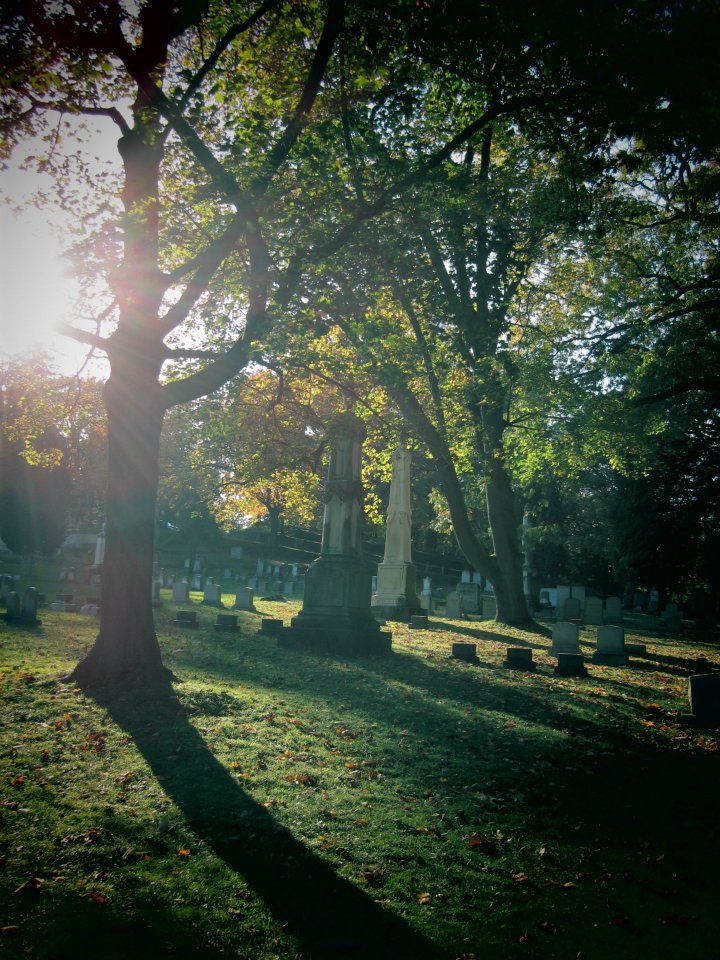
A few weeks ago, Aunt Kathy and I went on a tour of Mount Hope Cemetery in Rochester. We both pass by the cemetery all the time and it was really nice to actually take a few hours to stop and learn about it. Throughout most of the year the Friends of Mount Hope offers free guided tours on the weekends so we joined inand had an absolutely gorgeous fall day to tour on. Mount Hope is a 198 acre Victorian cemetery that was dedicated in 1838. It’s a very unique spot because the land was formed by glaciers so there are hills and valleys and its quite a workout to get around. There are over 375,000 people buried there, including some very famous Rochester residents. Our tour started at the plot of the Sibley’s. Hiram Sibley founded Western Union and was instrumental in the purchase of Alaska. Our guide pointed out 4 stones set in the ground that formed the borders of the plot. Apparently in the old days, families would come to their burial plots for a Sunday picnic as this was a nice place to relax. May as well get some use out of it while you are still alive I guess!We saw the grave of Susan B Anthony, who was a pioneer of the women’s rights movement. I learned so much about her and it was fascinating! I learned that when the police came to arrest her for voting she asked to change her dress first and then they took her to jail on a streetcar. After her arrest and prior to her trial, Anthony traveled across Monroe County (where her trial was to be held) and gave impassioned speeches in why women should have the right to vote. The DA obtained a change of venue because he determined that a fair trial could not take place in Monroe County. The trial was moved to Ontario County, where Anthony proceeded to give more speeches. The Justice of the trial was horribly corrupt and sexist and did the following: refused to allow Anthony to testify on her own behalf, allowed statements given by her at the time of her arrest to be allowed as "testimony," explicitly ordered the jury to return a guilty verdict, refused to poll the jury afterwards, and read an opinion he had written before the trial even started! So of course she was found guilty but apparently back in those days people felt that women did not belong in jail, so they ordered her to pay a $100 fine which she never did because she knew they wouldn’t put her in jail.Anthony’s lawyer was Henry Seldon and he is buried at Mount Hope along with his son, George Selden who invented the gas powered automobile (take that Henry Ford).Rochester’s other most famous burial at Mount Hope is Frederick Douglass who is a famous abolitionist (and friends with Susan B Anthony). We also saw the grave of Henry Ward who was the founder of Ward’s Natural Science. There is a large boulder atop his grave that is flecked with red jasper. It is very unusual for a cemetery but fitting for his lifelong love of science.Mount Hope also has several sculptures from the Vatican sculptor, Papotti. Here is the Weary Pilgrim (who is missing a toe).

I had a great time playing around with all the setting on my camera to get some interesting pictures. Many people use the cemetery to jog or walk their dogs so it's not a creepy place at all. However, this one statue was pretty spooky as it was headless!

The tour lasted about 2 hours and was absolutely fascinating. We even got lemonade and cookies at the end! I would highly recommend this tour to anyone in the Rochester area as it provides tons of interesting information on our famous cemetery and its residents.